
题记
万象静穆,空山自古。
当一轮朗润如玉的明月悬于群峰之上,银辉泼洒在虬曲苍劲的古松林梢;当那一泓发乎绝壁冰壑的清泉,奔腾跳跃于青苔叠翠的万载顽石之间,这天地间最纯粹的造化之光,便与人类千百年来对澄澈、安宁与超然的极致渴望,在此刻交汇成一幅永恒的画卷。
此非单是辋川右丞王摩诘的一纸诗笺,亦非仅为画工笔底的一幅烟岚,它是一方隐退于尘寰之外的心灵净土,是一场宇宙静止与流动的玄奥对话。观此景者,洗心涤虑,物我两忘,独与天地精神往来。
第一章 悬天素魄:清辉与宿云的太虚长卷
夜幕无垠,群峰隐没在青黛与幽蓝交错的苍穹之下。视线越过重重山岚,最先牵引心神者,莫过于那轮高悬天心的皓月。
那是一轮饱满而浑圆的明月,宛如以天地造化之精魄琢磨而成的温润古玉,静静地嵌在广漠无垠的宝蓝霄汉之中。月轮之上,隐约可见斑驳若隐的桂树暗影与玉兔纹理,冷香清冽,不可逼视。它没有盛夏烈日的逼仄焦灼,没有斜阳残照的苍凉伤逝,唯有一种洞察世事沧桑后的宏阔与慈悲。这光芒穿过万仞虚空,照澈了万古长夜,亦照澈了眼前这一方静谧而澎湃的深山大壑。
凝视这片天幕,月轮周围并非空无一物的虚白,而是缭绕着层层叠叠、翻涌舒卷的浮云宿霭。那些云气薄者如素练轻绡,被月光自背后透射而出,边缘泛起淡淡的银蓝与珠贝般的微光;厚者如雪堆玉垒,在幽暗的夜空中显现出奇崛多变的岩壑形态。微风行于高天,宿云便在这孤月的清辉中徐徐移步,或聚或散,忽隐忽现。有时,一缕纤云自月盘边缘拂过,便如绝代佳人回眸时的轻纱遮面,使那浩浩月光多了一分内敛的朦胧与含蓄;而当云涛退散,素魄中天,光华倾泻如银瀑悬空,直教三千世界尽化为琉璃宝刹。
这月色,是宇宙间最深沉的沉默,亦是最宏大的包容。自上古伏羲仰观俯察,及至屈子天问、谪仙举杯,千百载的光阴在凡间不过是帝王霸业的化为尘埃、英雄美人的白发红颜,唯有这一轮明月,曾照拂过秦汉的长城,照拂过盛唐的长安,而今又毫无保留地照在这深谷孤松与空潭乱石之上。它不因深山之幽而减其色,不因幽兰独吐而隐其华。在它的照拂下,幽暗的山林不再沉闷可怖,反而生出一种剔透澄澈的明净。
仰首望月,俗世里积攒的营营苟苟、利禄虚名,在这浩瀚的清辉面前显得何其微不足道。月华似水,缓缓淋漓于身,仿佛能将人骨髓深处的浊气一一洗净,令人恍若羽化而登仙,心境登时随之升腾,与那高悬的素魄、流转的宿云融为一体,不辨古今,不知何夕。
第二章 铁骨龙鳞:古松偃仰与苍翠之境
月华倾泻而下,正迎上一尊巍然立于绝壁巨石之上的庞然生灵——那是盘根错节、老干擎天的千载古松。
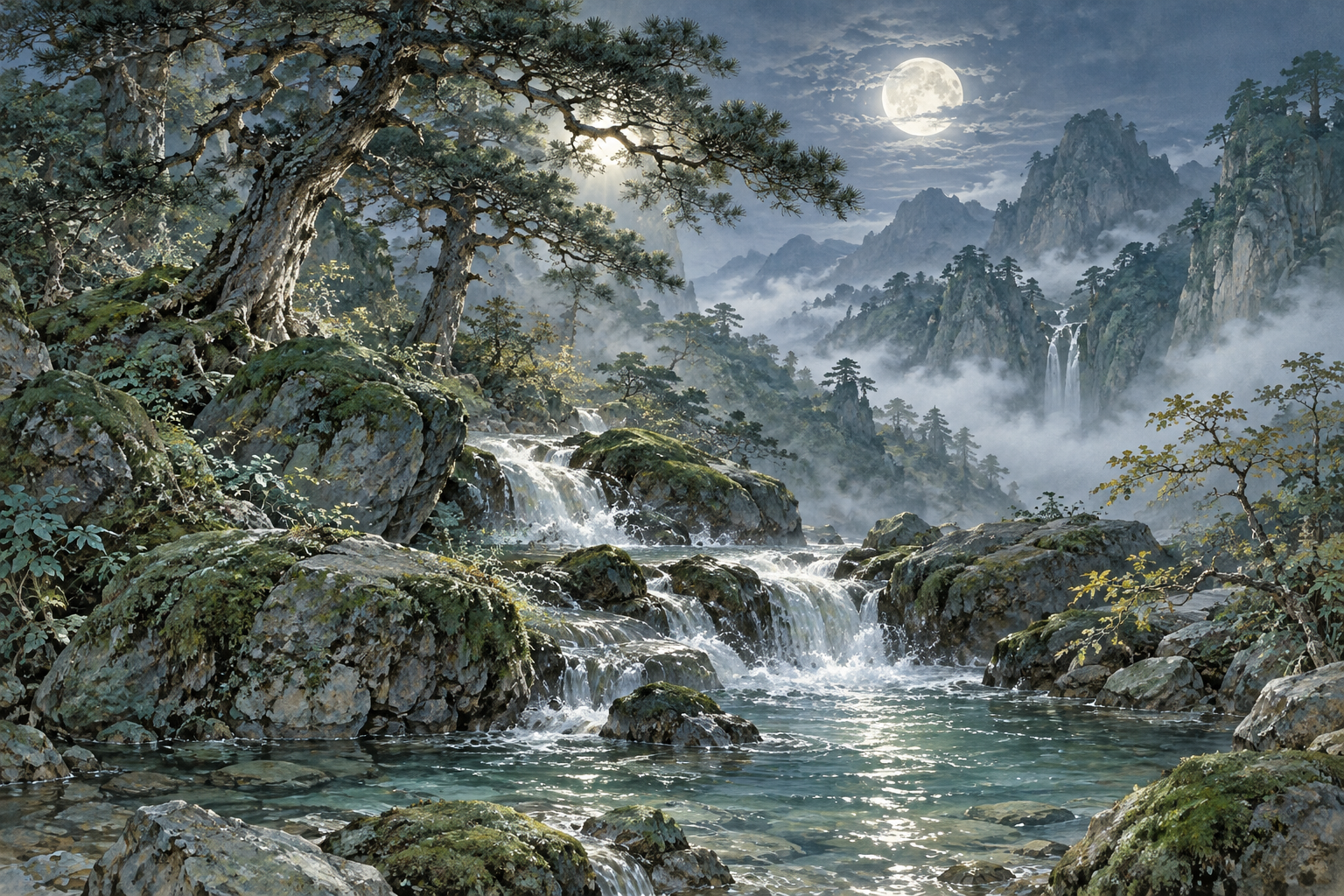
在这幅画卷的左侧,一株苍松如老龙起蛰,拔地而起。其主干粗砺如铁,表皮斑驳纵横,呈现出岁月斧凿刀劈般的层叠裂纹,宛若苍龙身上的铁甲鳞片,青灰、赭石与墨色相杂,凝结着千百年风霜雨雪的洗礼。它的躯干并非笔直向上,而是经历了千百次山风狂暴的撕扯与雷霆骤雨的淬炼,呈现出一种近乎倔强的屈曲盘旋之态。它向右侧苍凉横逸,凌空伸展,枝干如巨大的虬臂,庇护着下方的山谷与泉流,展现出一种“挺然拔俗、历千载而弥坚”的傲骨。
凝神细审那繁茂交错的松针与枝桠,造化与光影的奇迹便在此处绽放。那翠绿如泼的针叶簇生于细枝之末,疏密有致,如团团凝固的绿云。而那一轮清冷的明月,恰好穿行于这横斜交错的松枝缝隙之中。古人云“明月松间照”,若非亲眼目睹此景,断难领略这五字所蕴藉的无限精妙与神韵。月光不是简单地落于其上,而是被针叶与粗干无情而又多情地分割、折射。一束束冷峻的清辉穿透松针的网隙,在夜雾中化作清晰可见的银色光柱,仿佛自天穹直插人间的神圣琴弦;另有一些光芒则在苍老粗糙的树皮凹陷处凝固,将那些寄生于树干上的地衣苔痕勾勒得纤毫毕现。
在主干之后,更有数株伴生的松树在烟雾中或隐或现,它们姿态各异,有的如老僧入定,有的如武士当关,连绵成一片黛绿与暗银相融的苍郁之林。山风拂过,漫山松涛骤起,这声音初听如远海潮生,细听又如万马奔腾,继而又化为萧萧瑟瑟的天籁微响。松涛之声与山风的吐纳相交融,松脂那清冷、苦涩而又幽微的暗香,便随着这夜风与水气在空气中徐徐弥漫,沁人心脾。
这松,是山之筋骨,亦是君子之高致。它植根于最为贫瘠险峻的石缝之间,不择肥沃之土,不依丰茂之壤,唯凭一粒落自天际的松果,以柔弱的幼根刺破玄石,在绝境中汲取天地灵气。数百年来,它见惯了春花之谢、秋草之枯,见惯了山崩地裂、野火雷击,然而无论世间造化如何迁流,它始终郁郁葱葱,傲骨嶙峋。当夜晚的万籁归于寂灭,唯有这苍松与天上的明月相对无言,以千年的静默对应万古的苍茫,达成了自然界中最崇高而威严的默契。
第三章 惊涛碎雪:清泉石上流的清音画卷
松下有石,石间有水。视线自高渺的云天与伟岸的苍松缓缓下移,便跌入了那一片由水与石奏响的宏大交响乐章。
画面中的山泉并非平缓流淌的孱孱细流,而是一股自远山重峰之中呼啸而至、汇聚了百川冰雪的浩荡奔流。它自右上方险峻的峡谷奔涌而出,初时在幽深的山林间宛转隐现,继而顺着天然形成的层层阶梯状石矶,一路咆哮跌宕,倾泻而下。
在奔流至画面中心之际,激流遇到了最为坚固的阻遏——嶙峋突兀的黑色岩盘与参差不齐的巨石。水流并不退缩,亦不绕道,而是以摧枯拉朽、无所畏惧之姿猛烈扑向岩石的脊梁。刹那间,但见琼碎玉碎,雪浪翻滚!奔腾的泉水撞击在坚硬的石棱之上,激起千百道飞扬的浪花与洁白无瑕的水沫。那水沫在明月的逆光映照之下,每一颗水珠都反射着晶莹剔透的银辉,犹如漫天飞洒的夜明珠,又似深秋骤降的纷飞冷雪。
跌落石级的流水,拉扯出千丝万缕洁白如练的丝缕,它们依附着石体的起伏而变换形态:有的宽阔舒展,若白绢自九天垂落;有的纤细灵动,若银丝在乱石间穿梭;有的则在跌落的深涡中相互拥抱、旋涡激荡,泛起一层层厚重绵密的乳白泡沫。
更为精妙的是水色与光影的变幻。在瀑布跌落之后汇聚的开阔潭水之中,水流骤然放缓,呈现出一种近乎梦幻的碧翠与冷绿。这池水澄澈得令人心悸,深处如凝碧的美玉,青翠欲滴;浅处则透明见底,连水下静卧千百年的鹅卵石纹路都历历在目。月光自苍松的枝叶空隙斜斜穿透下来,在微澜起伏的水面上洒下一道道细碎闪烁的银光,有若千百条银鳞小鱼在水面跳跃嬉戏,又似天上被打碎的星辰散落于人间清潭。
听,那泉水的声音!在万山空寂的深夜,这水声便是天地间最美妙的律动。远处的跌瀑声若隐雷滚滚,低沉而悠远;中景的奔流撞石声清脆激昂,若千面羯鼓齐擂、万柄铁骑冲杀;而到了前景近处的平潭回水,那声音又渐渐转为温润细密的佩环相击,叮咚作响,如高山流水之操,诉说着不尽的灵动与从容。
水无常形,因势而赋;水无常质,遇石而明。这清泉从雪山孤峰之巅发源,本是天下至柔至弱之物,却能穿行于万仞重峦,劈开阻路巉岩,在石壁上冲刷出温润的沟壑。它在坠落中获得升华,在破碎中成就圆满,哪怕被顽石击得粉身碎骨,亦要在月华之下绽放出最璀璨的水花。这一脉灵动的水,赋予了原本冷峻枯寂的群山以鲜活跳动的灵魂。
第四章 万载青苍:磐石骨相与苔衣苍润
清泉奔流所依凭的,是那些盘踞在山谷之中、千百年来任由风浪涤荡的万千巨石。
画幅前景与中景之中,巨石累累,大小不一,其势犬牙交错,森然有阵。这些岩石绝非市井园林中人为垒砌的假山假石,而是经历了地壳隆起、洪流切割、严霜剥蚀的大荒遗物。它们体量沉重,骨力坚拔,每一块巨石的棱角都被岁月的刻刀打磨得苍凉而圆润,呈现出一种沉穆内敛的“古拙”之美。岩石的肌理繁复多变,或如斧劈,或如麻乱,暗红色的赭石底色与青黑色的冷光相互浸润,在月色与水光的交织下,散发着金属般坚固的光泽。
尤其引人瞩目者,是覆于这些巨石之上的厚厚苔衣。
在急流冲刷不到的石背与石侧,生长着大片大片毛茸茸、深浅不一的绿苔。那绿,不是初春新柳的嫩黄轻浮,亦非盛夏重树的墨绿沉郁,而是一种历经了百千次泉水滋润、吸饱了山川清气的“古苔绿”。它们像是大自然为这冰冷坚硬的石骨特意披上的一袭翡翠羽衣。月光斜照在青苔之上,因其表面细密的绒毛与晶莹的水露,散发出一种柔和而温润的哑光质感,恍若古玉出土时散发的微芒。
在有些巨石的裂隙深处,甚至还探出几丛不知名的幽草野木,细碎的绿叶在夜风与水沫的拂动下轻轻颤动,舒展着娇小的生机。青苔与野草的存在,彻底消解了巨石的暴戾与冷硬,赋予这片山谷以无尽的温情与岁月的厚重。
石,乃天地之骨骼;水,乃天地之血脉。在这幅长卷中,石与水构成了大自然最深沉的一组矛盾与统一。石是绝对的静止,是永恒的坚守,是任凭沧海桑田而巍然不动的执着;水是极致的流动,是瞬息的变幻,是奔腾不息、从不驻足的向往。千百年来,水不停地抚摸着石,以其至柔之躯试图融化石的冷酷;石坚定地承受着水,以其至坚之脊骨激扬出水的壮美。没有石的阻拦,水便沦为平庸的泛滥,无以显现出激荡翻飞的英姿;没有水的润泽,石便不过是荒山死寂的顽物,无法展露出青苔古雅的生机。
“清泉石上流”,这五个字不仅勾勒出了清冽动人的视觉意象,更道尽了动静互涵、阴阳相生的宇宙大化之理。在此处,动极而生静,静极而复动,水磨石穿,石伴水流,达致了一种不可分割的完满与平衡。
第五章 烟岚重峦:空山远嶂的幽邃意境
若将目光从近处的古松、飞泉与苔石稍作抽离,投向画卷的中景与远方,一片更加辽阔、幽深、浩渺的世界便在薄雾与月色中徐徐铺展。
在右侧中景处,一道纤细如素练的瀑布自更为高耸的悬崖峭壁间垂挂而下,宛如自九天织锦落下的白绸,静静地注入迷蒙的深谷。围绕着这处飞瀑的,是数道起伏跌宕的崇山峻岭。山峰壁立千仞,奇峰罗列,有的如剑戟直指苍穹,有的如屏风横断虚空,峰顶之上同样点缀着零星傲立的孤松,与前景的巨松遥相呼应,构成了画卷层次分明的空间韵律。
而在这些重峦叠嶂之间,最令人心折的莫过于那流淌漫溢、吞吐万象的乳白烟岚。
深山之夜,湿润的水气自飞瀑与清潭中不断蒸腾,遇冷而凝结为重重夜雾。这雾气在山谷之间轻盈地游走,将山脚与山腰完全隐没,仅留下数座险绝的青峰露于云海烟波之上,恍若海上漂浮的蓬莱仙岛。烟岚随着山风的呼吸而流动,时而浓厚如雪毯,将半壁江山遮蔽得严严实实;时而轻薄如青烟,让远山原本刚硬的轮廓在月光下变得如梦如幻,虚无缥缈。
这种“虚实相生”的造境手法,深得中国古典美学“计白当黑”之精髓。倘若满幅皆为巨松怪石、急流飞瀑,未免显得逼塞而窒息;而正是这一抹抹流淌在群山之间的烟云与留白,为整幅山水注入了呼吸与冥想的巨大空间。它让观者的视线得以在虚空中徜徉,让心灵得以在浩渺中安放。
山不在高,有仙则名;境不在远,有幽则灵。这幽深浩渺的远嶂,让人不禁遐想:在那白云深处,在那悬瀑之畔,是否有一方结庐而居的茅庵?是否有一位披发长啸的隐者,正松下抚琴,坐看云起?古人之所以钟情于此等深山绝壑,非为避世弃智,实为在与这雄浑博大的天地相处中,重寻生命本真的宁静。山峦的沉默给予人以定力,烟云的幻灭给予人以超脱,当一个人面对如此深邃广袤的宇宙空间时,一切世俗的纷扰都会在瞬息间归于虚无。
第六章 辋川流韵:王摩诘与中国文人的精神原乡
凝视着眼前的月照古松、泉流怪石,耳畔似乎穿越了千余年的时光风雨,再度回响起那位盛唐诗佛王维在《山居秋暝》中低吟的长调:
空山新雨后,天气晚来秋。
明月松间照,清泉石上流。
竹喧归浣女,莲动下渔舟。
随意春芳歇,王孙自可留。
这幅画卷,无声地将千百年前诗句中所蕴含的禅意与神髓,具象化为了眼前的笔墨视觉奇观。
在盛唐那个烈火烹油、锦绣繁华的伟大时代,王维官至尚书右丞,曾身历开元盛世的煌煌气象,亦曾经历安史之乱的颠沛流离与血雨腥风。在看透了官场的虚妄与世事的浮沉之后,他选择在蓝田辋川营建自己的精神避难所。在那里,有欹湖、孟城坳、辛夷坞、白石滩,更有无数个如眼前这般月白风清的寂静之夜。
王维笔下的“空山”,并非草木不存、飞鸟绝迹的荒芜死寂之所,而是一种“山林虽寂,灵性自存”的高级生命状态。“空”是佛教禅宗的最高境界,是扫除了一切执念、分别心之后的彻底澄明。正因为心“空”,方能敏锐地体察到秋雨初晴后天地间最细微的律动;正因为境“空”,那一轮破云而出的明月才显得如此纯净超拔;正因为万籁俱寂,那一泓击打在山石上的清泉才显得如此空灵绝俗。
千百年来,中国的士大夫文人无论在庙堂之上如何显赫,抑或在贬谪途路中如何落魄,他们的内心深处始终珍藏着一个王维式的“辋川梦”。在得意时,它是警醒虚妄名利的清凉剂;在失意时,它是安顿破碎心灵的终极港湾。陶渊明的“采菊东篱下”,尚带有躬耕陇亩的烟火劳作之气;而王维的“明月松间照,清泉石上流”,则完全抽离了尘世的物质欲望,升华成为一种纯粹的精神观照。
在眼前这幅绝美的画面中,我们找不到一丝人烟市井的痕迹,没有华服车马,没有瓦舍高楼,甚至没有浣女与渔舟的声响,唯有天地造化本身的孤明与自足。然而,观者却丝毫不觉孤寒凄凉,反而能从那苍松的傲骨、激泉的奔流、皓月的朗照中,感受到一种博大而深沉的生命暖意。这种审美传统,早已融入了中华民族的文化血脉之中,成为我们在面对任何风雨飘摇时,依然能够保持精神优雅与从容从容的最高源泉。
第七章 浮世澄怀:在喧嚣现世中独造一座深山
时光流转至当代,文明的列车在钢筋水泥与算力网络的轨道上风驰电掣。摩天大楼遮蔽了皓月与星河,车水马龙淹没了松涛与泉鸣,信息的狂潮将现代人的内心撕扯得支离破碎。我们获得了前所未有的物质丰盛与沟通便利,却在无休止的焦虑、内耗与追逐中,逐渐丧失了感知一朵花开、一缕微风、一轮圆月的通透心灵。
正因如此,凝视眼前的这幅图景,便不再是一种简单的审美消遣,而是一场急迫而深刻的心灵救赎与精神突围。
我们每个人,在这喧嚣浮躁的尘世间,何尝不似一块被命运的急流裹挟奔波的顽石?又何尝不像那被生活的重担压弯了腰身的苍松?我们在得失之间患得患失,在毁誉面前心潮起伏。我们渴望获得内心的真正平静,却往往在向外的盲目索求中迷失了方向。
古人云:“澄怀观道。”若想体会这明月松间的至美,必先荡涤胸中的块垒与尘埃。
试着在深夜闭上双眼,将这幅画卷深植于神识之内:让那一轮天心明月悬挂于你的头顶,以它的朗润与包容,抚平你眉宇间纠结的愁绪;让那一股冰壑清泉穿透你的胸膛,冲刷掉积郁在脏腑间的委屈、不甘与戾气;让那一株巍巍苍松化为你的脊梁,在人生的任何风霜与绝境中,依然保持站立的傲骨与向上的尊严;让那一尊生满青苔的磐石成为你的定力,任凭外界如何风吹浪打,我自岿然不动,守住生命最初的纯粹与本真。
明月何须独在深山?只要心存澄澈,纵在陋室蜗居,亦可开轩纳微凉;清泉何须必在绝谷?只要意守纯静,纵处闹市喧阗,亦能于耳畔听惊涛。真正的隐逸,从来不是遁入深山老林的逃避,而是身在红尘万丈之中,心中却拥有一座永不沦陷的山水庄园。
尾声:永恒的交响
夜色渐深,月华愈发皎洁。
那苍松依旧在夜风中徐徐展枝,吐纳着天地间无穷无尽的苍茫与旷达;
那飞泉依旧在磐石上纵情跳跃,激荡出千百道晶莹剔透、粉身碎骨却又绝美非凡的银浪;
那山岚依旧在远峰间聚散开合,书写着大自然变幻莫测却又永不终结的诗篇;
那明月依旧在九霄之外静默凝视,以一束亘古不变的清晖,照亮着过去,照亮着当下,亦照亮着所有追寻光明与安宁的远方灵魂。
万籁俱寂,天地皆空。
在这“明月松间照,清泉石上流”的至高胜境里,时间停驻了脚步,宇宙显露了真容。而我们,终于在这无声的画卷中,找回了那个久违的、澄明而安详的自己。
The Moon Amidst the Pines, The Spring Across the Stones
Inscription
All myriad things rest in profound stillness; the deserted mountain has stood tranquil since antiquity.
When a bright moon, lustrous as flawless jade, hangs suspended above rugged peaks, spilling silvery radiance over the gnarled, sinewy boughs of ancient pines; when a clear torrent, born of sheer cliffs and glacial ravines, surges and bounds amidst moss-draped boulders that have endured for millennia—the purest creative light of Heaven and Earth converges with humankind’s age-old longing for lucidity, serenity, and transcendence, distilling into an eternal scroll.
This is not merely a poetic scrap from the brush of Wang Wei, Vice Director of the Right at Wangchuan; nor is it simply a painted veil of mountain mist rendered by an artisan’s hand. It is a sanctuary of the soul sheltered far beyond the mortal dust, an esoteric dialogue between the cosmos’s stillness and its ceaseless flow. Whosoever beholds this vision purges their mind, cleanses their cares, forgets both self and external things, and communes in solitary communion with the spirit of Heaven and Earth.
Chapter I: The Unblemished Sphere in the Empyrean: An Infinite Scroll of Pale Radiance and Drifting Clouds
The night extends boundless and vast, with undulating peaks fading beneath a canopy woven of deep indigo and shadowy azure. Glancing past layers of mountain haze, that which first captures the soul is none other than the luminous full moon riding high in the celestial zenith.
It is an orb both plump and perfectly spherical, like antique jade ground and polished from the quintessence of Heaven and Earth, set quietly into the sapphire empyrean. Across its face one glimpses the faint, dappled silhouettes of mythical cassia trees and the tracery of the Jade Hare, exuding a chilled, piercing fragrance so pure it defies bold gaze. It possesses neither the sweltering tyranny of the midsummer sun nor the desolate grief of dying twilight; instead, it radiates an expansive magnanimity and gentle compassion born of beholding the vicissitudes of all ages. Its beams pierce ten thousand cubits of void, illuminating the eternal night, and laying bare every contour of this deep, roaring gorge nestled in the hush of the mountains.
Gazing up at this vault, one sees that the moon is not framed by blank void, but embraced by billows of wandering vapor and lingering nocturnal clouds. Where the vapors thin, they resemble wisps of unbleached silk backlit by lunar glow, their fringes shimmering with delicate silver-blue and pearlescent iridescence; where they thicken, they pile like banks of snow and ramparts of jade, mimicking the rugged, volatile architecture of the crags below. A high wind stirs the upper heavens, prompting the night clouds to drift leisurely through the moon’s solitary radiance—clustering and dispersing, now hiding, now revealing. Now and then, a gossamer ribbon flits across the moon’s rim, like a veil cast over the face of a peerless maiden turning her head, lending the vast, pouring light a touch of bashful reticence; yet when the sea of clouds recedes and the pure sphere reigns alone, its luster cascades like a hanging cataract of liquid silver, transforming the three thousand realms into a sanctuary of lapis lazuli and glass.
This moonlight represents the cosmos’s deepest silence, as well as its most all-embracing grace. From the archaic age when Fuxi looked upward to observe the heavens and downward to survey the earth, down to Qu Yuan chanting his Heavenly Questions and Li Bai raising his goblet to the skies, millennia in the mortal realm have been little more than imperial ambitions crumbling into dust, heroes turning grey, and beauties fading. Yet this solitary moon, which once bathed the ramparts of Qin and Han and shone upon the avenues of Tang Chang'an, now pours itself without reserve over this lonely mountain pine and these jagged rocks beside the silent pool. It does not withhold its radiance because the valley is remote, nor does it veil its beauty when the hidden orchid blooms alone. Beneath its vigil, the somber forest ceases to be oppressive or forbidding, unfolding instead in a crystal clarity of crystalline stillness.
Looking up, one feels all the petty strivings, illusory honors, and worldly entanglements of human life shrink into sheer insignificance before this immense clarity. The lunar light washes over the body like cool water, cleansing away the dull sediment deep within the marrow. One feels almost as if shedding mortal weight to ascend as an immortal, the spirit rising to merge with that radiant orb and the drifting clouds, oblivious to past or present, unaware of what hour of what epoch it might be.
Chapter II: Iron Bones and Dragon Scales: The Contorted Majesty and Everlasting Verdure of Ancient Pines
As the lunar flood descends, it meets a monumental presence rooted upon the craggy precipice: an ancient pine, centuries old, its gnarled roots coiled like serpents, its weathered trunk propping up the firmament.
To the left of the scene, this venerable tree rears up from the earth like an awakening dragon shaking off slumber. Its trunk is rugged as iron, its bark cracked and scarred by the chisel of time, resembling the armored scales of a dark mythical beast. Mottled with slate-gray, russet, and soot, it bears the frozen testimony of countless seasons of tempest, frost, and gale. Its bole does not shoot upright in compliant grace; tempered by the violent tears of mountain winds and lightning-laden squalls, it twists and rears in defiant contortions. Leaning boldly to the right, it casts its massive limbs across the void, arching like an outstretched arm over the chasm and the foaming waters below—embodying an unbending pride that transcends vulgar dust and grows only sturdier with each passing millennium.
Peering into the dense lattice of needles and twigs, one witnesses the miracle of natural light and shade. Needles of deep, splashed jade cluster at the tips of slender branches, spaced in exquisite harmony like frozen canopies of emerald cloud. And there, caught within the angular crisscross of the boughs, hangs the chilling moon. When the ancients wrote, "The bright moon shines through the pines," one cannot grasp the inexhaustible subtlety of those words without beholding this very interplay. The moonlight does not merely fall; it is fragmented, refracted, and sculptured by bark and needle. Beams of austere luminance strike through the mesh of evergreen, casting distinct pillars of silver through the humid mist—like sacred strings stretched from heaven to earth—while other shafts pool within the crevices of furrowed bark, delineating every crust of lichen and moss with diamond clarity.
Behind the primary trunk, sister pines loom and fade in the billows of mist. Diverse in posture, some stand poised like monks in deep dhyana, while others guard the ridge like sentinels in armor, blending into an undulating woodland of midnight green and muted silver. When the mountain gale sweeps through, a swell of pine-surf surges across the slopes. At first it murmurs like the tides of a distant ocean; soon it rumbles like a charge of ten thousand steeds; then it softens into the whistling, rustling sigh of celestial music. As the voice of the pines mingles with the respiration of the wind, the bitter, cool, elusive resin of pine scent drifts on the nocturnal mist, seeping straight into the soul.
This pine is the bone and sinew of the peaks, and the living emblem of the noble heart. Taking root in barren crevices of precipitous rock, it asks neither for rich loam nor sheltered ground; from a single pinecone drifted from the heights, its tender rootlets split basalt, drinking the raw vital essence of Heaven and Earth in extremes. Across centuries, it has watched spring blossoms wither and autumn grasses rot; it has witnessed landslides, raging fires, and lightning strikes. Yet however the world shifts, it remains unyielding, ever-green and iron-limbed. When the voices of the night dissolve into extinction, only this ancient pine and the moon overhead abide in silent contemplation—answering primeval eternity with millenary stillness, bound in the most solemn harmony that nature can devise.
Chapter III: Crashing Billows and Shattered Snow: The Resonant Splendor of Water Streaming Over Stones
Beneath the pines lie stones; amidst the stones runs water. Gliding down from the soaring sky and the majestic branches, one’s gaze plunges into the grand symphony orchestrated by rock and stream.
The spring depicted here is no languid, murmuring brook; it is a mighty torrent gathering the melted snows and chill rains of a hundred peaks, roaring down from the upper heights. Surging out of a forbidding gorge on the upper right, it weaves through shadows of the virgin forest before plunging down stepped ledges of native rock, tumbling, leaping, and spilling forth in tempestuous vigor.
Reaching the center of the scene, the cascade confronts its fiercest obstacle: jagged outcroppings of dark bedrock and uneven, towering boulders. Rather than retreating or veering aside, the water hurls itself upon the spine of the stone with fearless, all-shattering momentum. In that instant, jade shatters, pearls splinter, and foaming billows churn! The rushing cataract smashes against the stone’s unyielding prow, throwing up myriad plumes of spray and spotless froth. Backlit by the lunar beam, each suspended droplet glitters with lucid silver fire, resembling a shower of luminous pearls flung across the dark, or a sudden squall of late-autumn snowflakes adrift in the wind.
Spilling over stone tiers, the current tears itself into myriad gleaming white threads, conforming in infinite variation to the contours of the boulders: here widening into a broad sheet of white silk draped from the heavens; there darting nimbly like silver filaments through stone crevasses; and in deep churns below, whirlpools collide and embrace, heaving up thick, frothy billows of milky foam.
Still more exquisite is the shifting interplay of hue and luminescence. Where the cascade settles into a broad pool, its velocity abates, adopting an almost dreamlike emerald and glacial teal. The pool is so clear it catches the breath: its depths look like congealed jade, heavy with vibrant viridian; its shallows are so transparent that the veins of smooth river-stones, resting there for ages, remain distinctly visible. Moonlight angling through the pine boughs casts fractured spangles across the rippling surface—flickering like schools of silver fish leaping in play, or fragments of shattered constellations scattered across this earthly pool.
Listen to the voice of this water! In the silence of the night, it provides the most magnificent cadence in all creation. The distant fall rumbles like subterranean thunder, low and remote; the central impact against the boulders sounds sharp and exultant, as if a thousand leather drums were being beaten in unison or armored cavalry were charging; yet where the water curls into the fore pool, the din resolves into the melodious clinking of jade pendants, tinkling like the ancient zither melody of High Mountains and Flowing Water, singing of boundless fluidity and unhurried grace.
Water owns no fixed shape; it takes form from the contours of the earth. Water owns no fixed temperament; it reveals its spirit upon striking the stone. Arising from glacial peaks, this spring is the softest, most yielding thing beneath the sky, yet it cuts through labyrinthine mountains, cleaves adamant crags, and polishes sheer cliffs into smooth flutes. It achieves majesty in falling, and attains perfection in shattering; though crushed against the boulders, it blossoms into the most dazzling spray beneath the moon. This vein of living water breathes a vibrant, pulsing soul into what would otherwise be a world of cold, petrified silence.
Chapter IV: Timeless Azure: The Stony Architecture and Lush Moss of Primeval Rocks
The ground upon which this spring races is none other than the cluster of gargantuan boulders that have rested in the mountain hollow, washed by storm and flood for thousands of years.
Across the foreground and middle ground, stones pile upon stones, varying in magnitude, interlocking in formidable, defensive formations. These are no artificial rockeries sculpted for urban gardens, but primeval relics wrought by tectonic upheaval, torrential gouging, and glacial frost. Colossal and immovable, their forms display an austere strength. The corners of every boulder have been smoothed by the whetstone of millennia, exhibiting an archaic simplicity born of stoic endurance. Their grains are intricate—some cleaved as if by great battle-axes, others tangled like hemp fibers—where underlying veins of dark ochre mingle with cool blue-black minerals, glinting with metallic resilience beneath the woven sheen of moon and water.
Most striking of all is the thick mantle of velvet moss clinging to their surfaces.
On the sheltered crests and flanks untouched by direct rapids, vast spreads of verdant moss flourish in uneven shades. This green is neither the frivolous yellow-green of early willows nor the oppressive black-green of midsummer canopies, but an "antique moss-green" nurtured by ten thousand mists and steeped in the mountain’s pure ether. It is as though Nature herself had draped a robe of feathered emerald over these cold, unyielding bones. When the moon casts its slanted light upon the moss, the tiny downy filaments, beaded with dew, yield a subdued matte sheen like freshly unearthed antique jade.
From the deeper clefts of the stone, unnamed wild grasses and dwarf shrubs reach out, their delicate leaves trembling in the damp breeze and flying spray, unfolding tender pulses of life. The moss and the wild shoots dissolve the harsh severity of the boulders, infusing the chasm with deep warmth and the profound gravitas of enduring time.
Stone is the bone of the universe; water is its blood. Within this landscape, stone and water enact nature’s most profound dialectic of polarity and unity. The stone is absolute rest, eternal resolve, immovable through tectonic shifts; the water is boundless movement, perpetual transformation, an unceasing surge that never pauses to look back. For eons, the water caresses the rock, seeking with its yielding form to soften that cold indifference; the rock bears the onslaught with stubborn majesty, using its adamantine spine to coax the water into soaring splendor. Without the rock’s resistance, the water would lapse into sluggish marsh, devoid of dramatic grace; without the water’s baptism, the rock would sit as lifeless mineral, bereft of the antique vitality of moss.
"The clear spring flows over stones"—these five words do not simply paint a picturesque image; they articulate the cosmological rhythm where stillness and motion contain each other, where Yin and Yang engender one another. Here, motion driven to its peak gives birth to peace, and stillness held in perfection fosters movement. Water wears away the rock while stone guides the stream, arriving at an indivisible wholeness and equilibrium.
Chapter V: Mists and Layered Peaks: The Deep Solitude of Distant Mountain Vistas
Lifting one's gaze from the immediate proximity of ancient pines, gushing waters, and mossy crags toward the middle distance and beyond, a wider, deeper, and more boundless realm unfolds through the moonlit haze.
In the middle ground to the right, a slender waterfall hangs like a skein of raw silk from high battlements of stone, dropping quietly into the misty abyss like white damask falling from celestial looms. Encircling this cascade are soaring ranges that rise in undulating waves. Sheer precipices vault thousand fathoms into the sky; bizarre peaks march in succession—some thrusting upward like halberds challenging the firmament, others stretching sideways like folding screens partition the void. Scattered solitary pines crest these summits, answering the giant pine in the foreground across vast chasms, shaping an architectural rhythm of depth and resonance.
Yet what captivates the spirit most amidst these serrated crags is the milky mountain vapor that drifts and swells, swallowing and exhaling the myriad forms.
Through the mountain night, moisture constantly evaporates from the falls and pools, condensing in the crisp air into dense nocturnal fog. These vapors drift with ethereal lightness through the glens, swallowing the footings and waistlines of the ridges, leaving only a few sheer needles floating above the sea of clouds, like the enchanted isles of Penglai adrift on cosmic waters. The mist breathes with the mountain wind—now gathering into a fleece of snow that blankets half the realm, now thinning into gossamer smoke that softens the iron profiles of the peaks into dreamlike phantoms.
This interplay of void and substance reflects the pinnacle of classical Chinese aesthetics: "Treating white space as ink." Were the canvas packed edge-to-edge with heavy trees, crags, and waterfalls, it would oppress with claustrophobic density; but these drifts of mist and emptiness allow the landscape to breathe and invite meditative pause. They grant the eye room to roam through the void, and the soul space to rest in the infinite.
A mountain needs not great height if an immortal dwells there; a realm needs not infinite distance if it possesses spiritual seclusion. These distant peaks awaken the imagination: deep within those white clouds, beside that hanging cataract, is there a simple thatched hermitage? Does an ascetic recluse with unbound hair sit beneath the pines, stroking a zither and watching the clouds arise? The ancients loved these remote gorges not to flee reality or abandon wisdom, but to recover original authenticity through communion with the vast cosmos. The silence of the peaks imparts steadfast stillness; the transience of the mist teaches detachment. Confronted with such measureless space, all petty human grievances vanish into nothingness.
Chapter VI: The Lingering Echoes of Wangchuan: Wang Wei and the Spiritual Homeland of Chinese Literati
Gazing upon these moon-drenched pines and rocks strewn in the current, one seems to hear across twelve centuries the voice of the Tang Dynasty's "Poet-Buddha," Wang Wei, chanting his Autumn Twilight in the Mountains:
After fresh rain upon the empty mountain,
The air brings evening with the autumn chill.
The bright moon shines through the pines,
The clear spring flows over stones.
Bamboos rustle as washerwomen head home,
Lotuses stir as a fishing boat glides downstream.
Though the sweet perfumes of spring may wither at will,
The wanderer of noble heart may well abide.
This vision wordlessly crystallizes the Chan epiphany and transcendent spirit of those ancient lines into a magnificent visual reality.
In the blazing splendor of the High Tang, Wang Wei rose to Vice Director of the Right. He witnessed the zenith of the Kaiyuan era, yet also suffered the dislocation and bloodshed of the An Lushan Rebellion. Having seen through bureaucratic futility and the fickle fortunes of life, he built his sanctuary in the hills of Wangchuan at Lantian. There lay Lake Qi, Mengcheng Hollow, Magnolia Enclosure, and White Pebble Shoal—and countless nights of pristine moonlight and cool mountain wind like the one we see here.
Wang Wei’s "empty mountain" is no barren wasteland void of birds and trees, but an exalted condition of being: "Though the woods are silent, the spirit abides." "Emptiness" (śūnyatā) is the pinnacle of Chan realization—the absolute clarity achieved once clinging and dualistic distinctions are swept clean. Precisely because the mind is empty, it senses the faintest quiver of life after autumn rain; precisely because the landscape is empty of vanity, the moon breaking through cloud appears so transcendent; precisely because worldly noise is stilled, the cataract leaping across the stone rings with such ethereal music.
For a thousand years, Chinese scholar-officials, whether basking in courtly honors or exiled to barren borders, preserved a "Wangchuan dream" in the depths of their hearts. In times of triumph, it served as a soothing antidote against worldly arrogance; in times of ruin, an ultimate refuge for bruised souls. Tao Yuanming’s "Plucking chrysanthemums by the eastern hedge" still carried the earthy warmth of rustic toil; but Wang Wei’s "The bright moon shines through the pines, the clear spring flows over stones" is entirely detached from material craving, elevated into pure metaphysical contemplation.
In this breathtaking panorama, not a trace of human habitation appears: no garments, no chariots, no tiles or towers, not even the laughter of washerwomen or the sweep of fishing oars—only the solitary brilliance and self-sufficiency of creation itself. Yet the observer feels no chill or desolation; rather, from the pine's nobility, the cataract's rush, and the moon's unblinking gaze, one receives a deep, expansive warmth. This aesthetic lineage has long flowed in the cultural veins of China, standing as the supreme reservoir of spiritual dignity and poise amidst every worldly tempest.
Chapter VII: Purifying the Mind in a Tumultuous World: Crafting an Inner Mountain Amidst Secular Clamor
Time has sped forward to our modern era, where the juggernaut of civilization races along tracks of steel, concrete, and fiber optics. Skyscrapers obscure the moon and constellations; traffic roar drowns the sigh of the pines and the roar of the spring; a relentless deluge of data splinters the human psyche. We have attained unprecedented material luxury and effortless connection, yet amid endless anxiety, internal friction, and pursuit, we have gradually lost the luminous sensibility needed to welcome a blooming flower, a stray breeze, or a full moon.
Thus, to contemplate this vision is no mere aesthetic diversion; it is an urgent, necessary redemption of the soul—a spiritual breakout.
Every one of us in this fevered world—are we not each like a rough stone swept along in the rapids of destiny? Are we not like that pine, bent under the burdens of survival? We torment ourselves over gain and loss; our hearts churn at praise or blame. We thirst for genuine inner peace, yet lose our way in frantic outward chasing.
The ancients said: "Purify the heart to behold the Dao." To taste the supreme beauty of the moon amidst the pines, one must first sweep away the obstructions and dust within the breast.
Try closing your eyes in the quiet of the night, planting this landscape deep within your consciousness: let that zenith moon hang above your crown, smoothing with its soft radiance the furrowed anxieties upon your brow; let that glacial torrent sweep through your chest, washing away the grievances, resentments, and petulance collected in your viscera; let that towering pine become your spine, keeping you standing upright in dignity through life's bitterest frosts; let that moss-clad boulder form your inner fortitude—though the winds howl and billows crash, you abide immovable, guarding the primordial purity of your true self.
Why must the bright moon dwell only in wild peaks? If the heart remains luminous, even in a humble room one may open the casement and welcome cool breeze. Why must the spring flow only in forgotten ravines? If the mind abides in tranquility, even amidst the clamor of the market one can hear the breaking waves. True reclusion is never an escape into mountain fastnesses; it is walking amidst ten thousand fathoms of red dust, while keeping an unbreachable sanctuary of peaks and streams alive within.
Epilogue: The Eternal Symphony
The night deepens, and the moon shines ever purer.
The ancient pine continues to stretch its boughs in the night wind, breathing the boundless immensity of heaven and earth;
The leaping cataract continues to bound across the boulders, casting up a thousand shattered yet sublime billows of silver;
The mountain mists continue to cluster and part across distant crags, inscribing nature’s protean, unfinishable poem;
The bright moon continues its silent watch from beyond the ninth heaven, using its immutable beam to illuminate the past, the present, and every distant soul seeking light and peace.
All sounds dissolve; heaven and earth are made empty.
Within this supreme sanctuary where the bright moon shines through the pines and the clear spring flows over stones, time stays its foot, and the cosmos reveals its true countenance. And here, within this silent scroll, we at last recover that long-lost self: luminous, lucid, and at peace.